Everything you ever wanted to know
How XTM supply, mining rewards, and the Turbine burn model work together to power the Tari network.
Two layers, one fair-launch protocol
The Tari network has two layers: Layer 1, the Tari base layer, and Layer 2 (the Ootle network). Layer 1 is secured by proof of work. Miners are rewarded with Minotari tokens (XTM). Layer 2 is a Byzantine fault-tolerant network fueled by the Tari token (XTR).
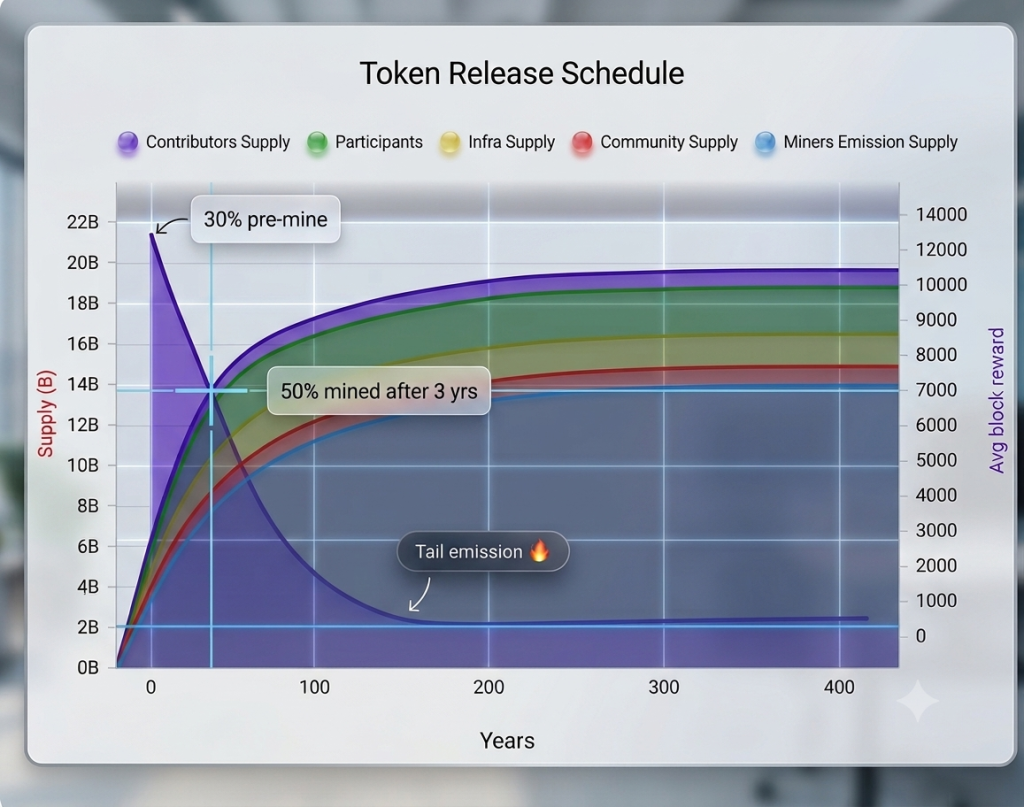
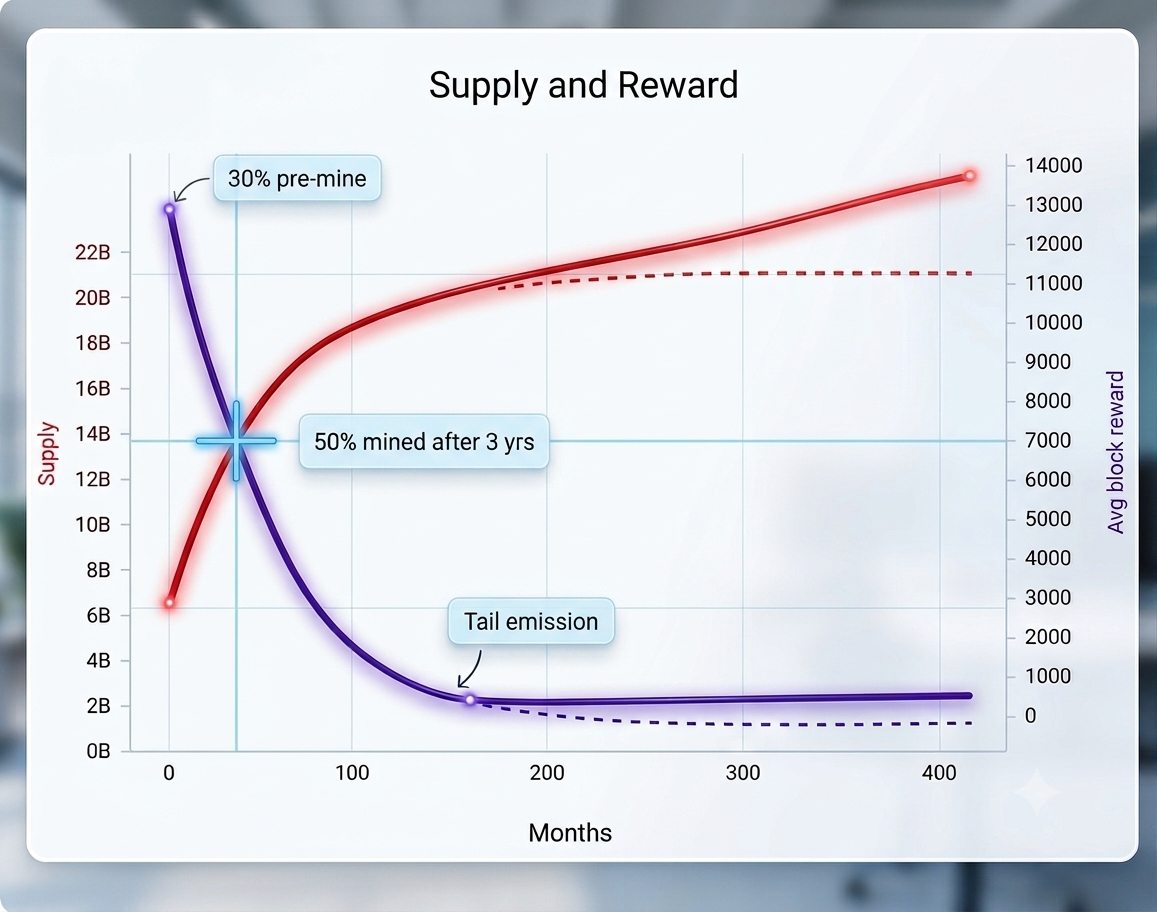
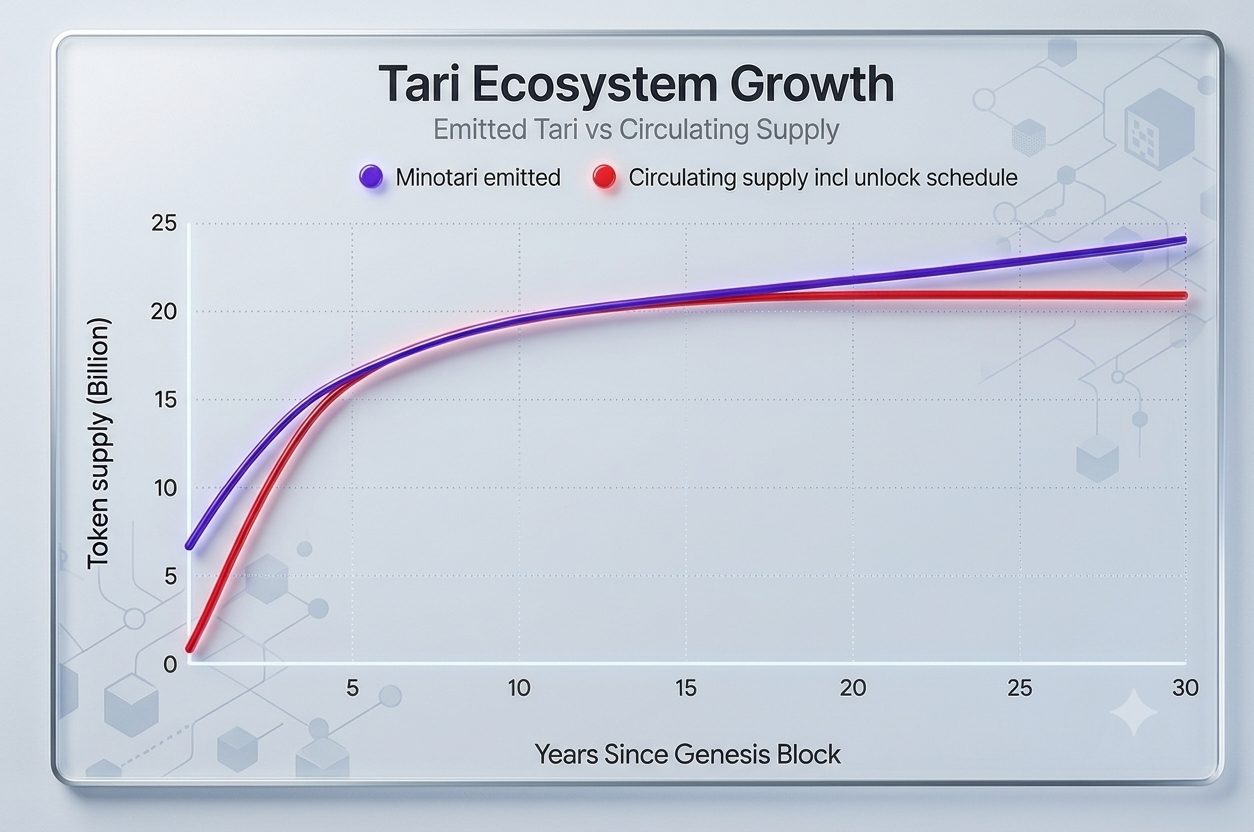
There will be a total supply of 21 billion XTM, emitted gradually using an exponential decay function over approximately 27.8 years. Once annual emissions decline to 1% of total supply, a perpetual 1% tail emission continues, ensuring ongoing miner compensation and network security. Of this total supply, 6.3 billion XTM (30%) are pre-mined, subject to significant lockups and vesting schedules. The pre-mined tokens will support protocol infrastructure, community incentives, grants, and long-term alignment with contributors. After the pre-mine distribution, all newly minted tokens (100%) will go exclusively to miners who secure the network.
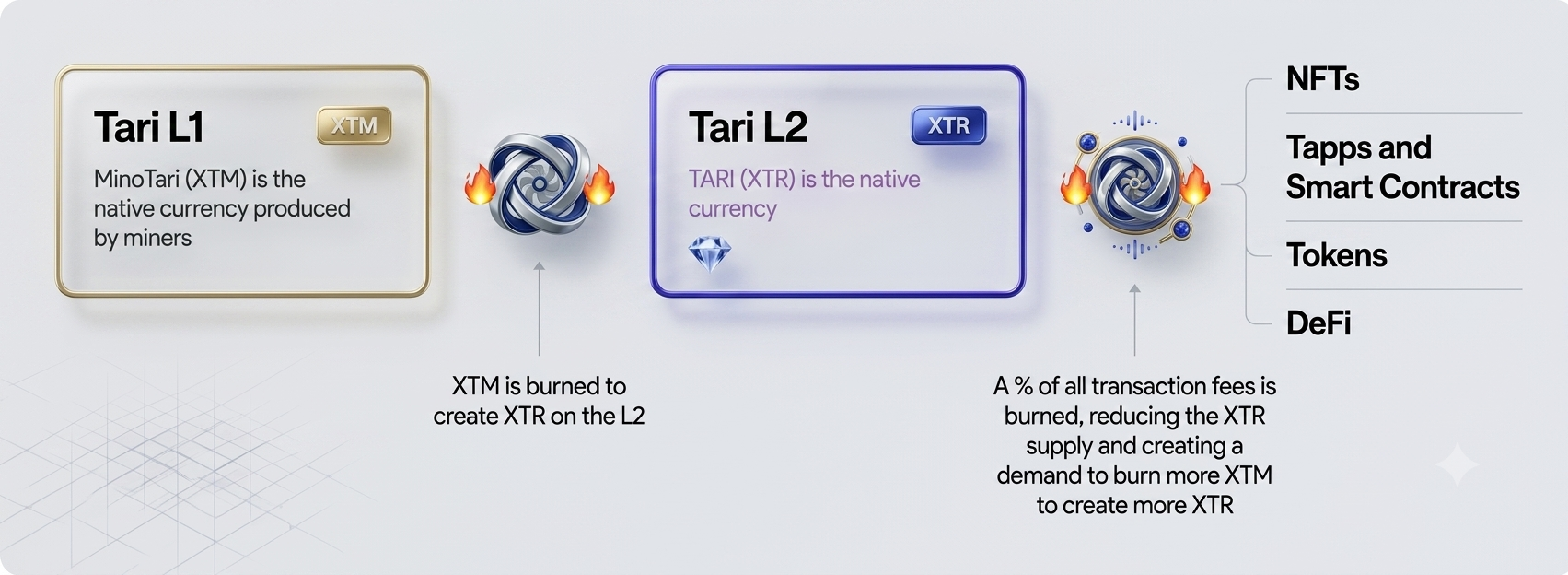
There is a deep relationship between XTM and XTR tokens. The only way to create XTR is to burn XTM on Layer 1. A transaction fee-oriented burn mechanism on the Ootle network will help ensure overall token supply equilibrium. There is much to cover, so let’s start with the Tari Layer 1 proof of work model and XTM.
Proof of work
Distribution as fair as it gets
Once considered the gold standard for securing blockchains, proof of work originated with Satoshi Nakamoto’s implementation for Bitcoin. Recently, it’s fallen out of favour among proof-of-stake consensus mechanisms. We strongly believe that in the coming months, there will be a renewed appreciation for Nakamoto Consensus. A blockchain consensus mechanism combining proof of work and the longest chain rule to achieve network agreement on the blockchain state. Anyone and everyone will be able to mine Minotari on Day 1, creating a world where everyone has a voice and an opportunity to participate in the network and shape its future. This accessibility brings a fair distribution that hasn’t been absent in recent projects. You don’t need to be an early investor or an airdrop farmer to get XTM; simply contributing raw hash power to the network is enough.
Tari miners receive XTM for every block they mine, with block rewards declining on a block-by-block basis. In the first 12 years after the mainnet launch, the Tari protocol employs a tail emission model. After 12 years, the protocol rewards miners via a tail emission to ensure they receive compensation forever for securing the network. The tail emission increases the XTM emitted by 1% a year. Tari miners receive 100% of block rewards and Layer 1 transaction fees.
Unlike Bitcoin, which operates on a 4-year halving schedule, the Tari block rewards decrease steadily over time, block-by-block, through an exponential decay function, halving approximately every three years.
Network rewards are split 50/50, with half of the Tari block reward going towards merge mining performed with the RandomX hashing algorithm and 50% of the block rewards going to Tari standalone miners using the SHA3x hashing algorithm. RandomX is a proof of work (PoW) algorithm designed to be ASIC-resistant by optimizing for general-purpose CPUs, ensuring fairer, more accessible, and more decentralized mining. The merge-mining aspect of Tari will enable existing RandomX miners to increase their revenue and keep them successfully mining both the RandomX chain and Tari for the foreseeable future. The Tari protocol bakes this 50/50 distribution into the consensus rules.
Burn baby burn
The Turbine Model
All dApps (tapp) activity will occur on the Tari Layer 2 (the Ootle), including DeFi, NFTs, SocialFi, GameFi, stablecoins, streaming payments, and more. Tari contributors have designed an elegant relationship between the Layer 1 token (XTM) and the Layer 2 token (XTR) to offset supply inflation and reward the network as they progress between them. Tari contributors achieve the Turbine Model this way.
XTM to XTR
The Throttle
The Turbine Model enables Tari to maintain a soft 1:1 peg between Minotari (XTM) and Tari (XTR) without using complicated peg-out mechanisms like drive chains or federated pegs.
Other things being equal, greater activity on the Ootle depletes the supply of Tari tokens faster. Mining rewards on the Minotari network in the form of XTM replenish the supply of XTR.
The Throttle actively controls the burn rate for XTR associated with every transaction on the Ootle. The Throttle is an algorithm run via consensus by validator nodes that periodically adjusts the burn rate to maintain the stability of the Tari ecosystem. The Throttle has three priorities in decreasing order of importance: to i) maintain the XTM: XTR peg, ii) maintain a stable supply of XTR + XTM, and iii) maintain a total token supply of 21 billion tokens.
Tari’s fast finality, sub-penny transaction fees, infinite scalability, programmable confidentiality features, and superior user experience make it the best platform to become the default value layer of the internet.
Slowly and then all at once.
Token distribution
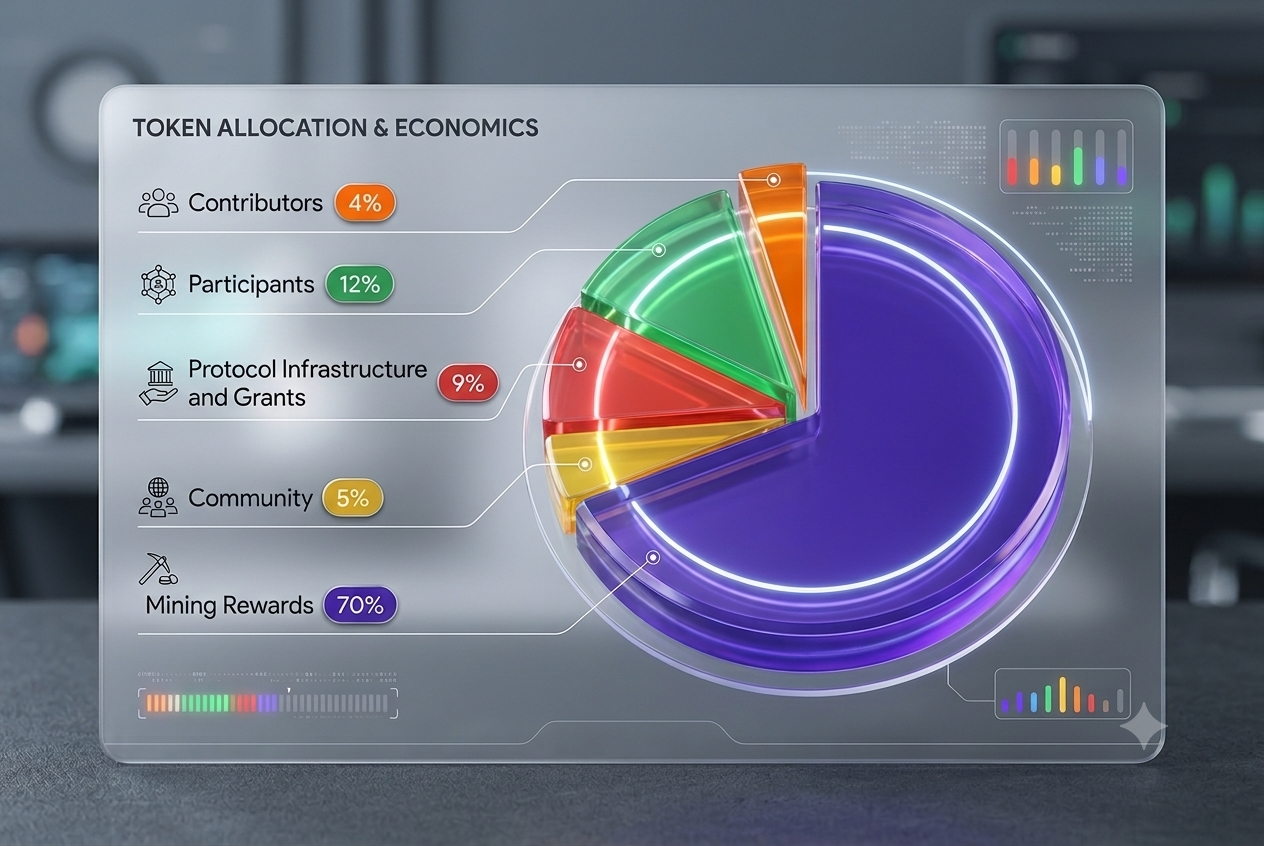
70% to miners, 30% pre-mined
With 70% of the initial emission of XTM tokens going to miners, what’s the deal with the 30% pre-mined XTM tokens? The other 30% pre-mine is broken into four categories: Community, Protocol Infrastructure and Grants, Contributors, and Participants. Let’s talk about each in detail.
Community
Protocol Infrastructure and Grants
Contributors
Participants
Unlock schedule
How to pre-mine and vest over time
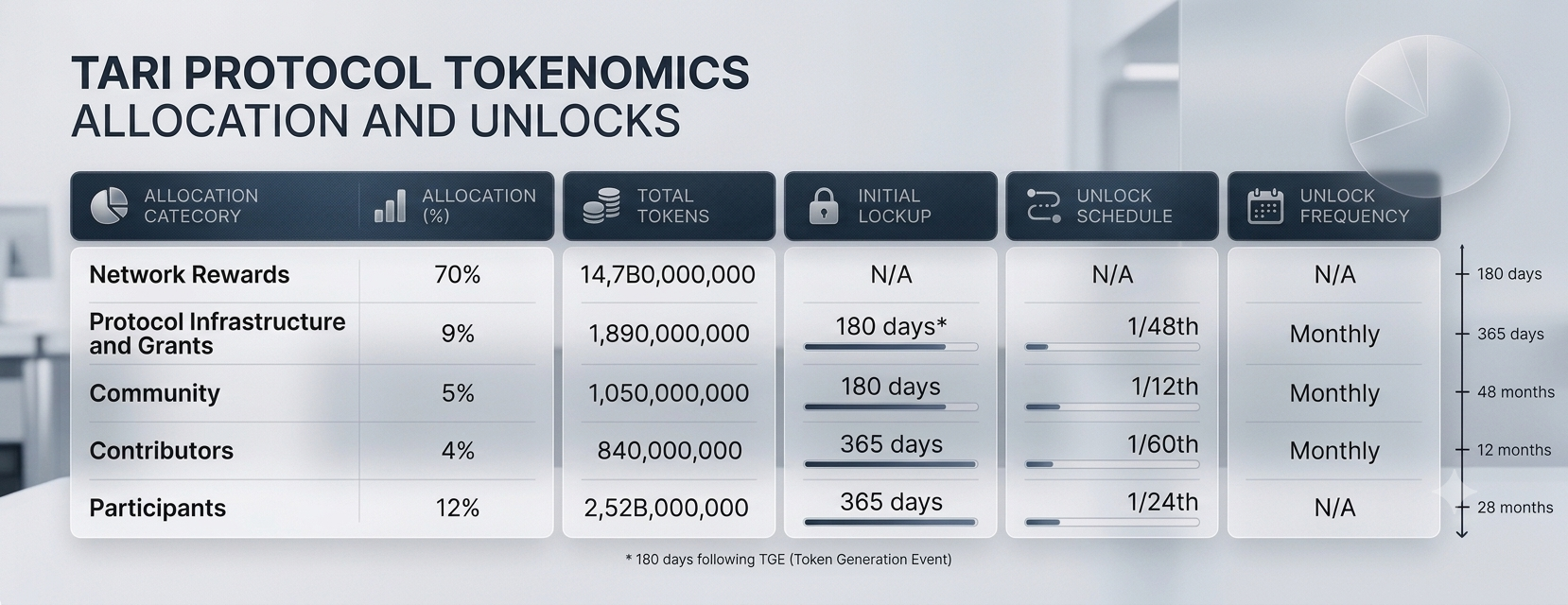
30% of the Protocol Infrastructure and Grants allocation will be reserved and available upfront for protocol liquidity.
Community tokens unlock every month for 12 months beginning six months after the mainnet launch. Protocol infrastructure and grants tokens unlock every month over 756,000,000 tokens available for four years, starting six months after the mainnet launch. Contributor tokens unlock every month for five years, beginning 12 months after the mainnet launch. Participant tokens unlock every month for two years, beginning 12 months after the mainnet launch.